Gods and Snakes Part 2
What to do?
This post is part of a series on my process and progress working on a capstone project for General Assembly’s Data Science Immersive course.
In Part 1 of this series, I talked about three potential projects to serve as my capstone for General Assembly’s Data Science Immersive. Well, as with many things, my plans were too grand and quickly outpaced my speed and ability. Here is a quick summary of the projects again:
- A tool/script/webapp etc. to automatically segment ancient Greek text according to the (big word incoming) morphophonemic method.
- A tool/script/webapp etc. to scan prosody and output the metrical units etc.
- Make an attempt at predicting authorship of texts based on…well that’s the data science part I guess.
BLUF: I didn’t choose any of these projects.
Before I get to what I chose for my project, let’s look at these projects individually to get an idea of the scope and why I decided to go in another direction altogether. To get started, we’re going completely out of order and starting with #3, predicting authorship. So here’s the scoop:
In broad strokes, you train a model on various features — average sentence length, vocabulary, maybe even the “tone” — of a known author or group of author’s text and then use that model to predict the author of a text which the model has not previously seen.
The underlying assumption is that authors have a certain style that a model can “learn” and compare against texts from another author. This is of course more or less difficult depending on many things, such as those features I mentioned earlier. A few examples:
- George R.R. Martin’s vocabulary is unsurprisingly similar to that of another fantasy author like J.R.R Tolkien.
- George R.R. Martin’s vocabulary differs greatly from J.K. Rowling, despite both belonging to the fantasy genre.
- The narrative point of view used by each of these three authors is different, despite any other similarities.
You may not even agree with those examples, people fight over how much one author is like another all the time. Add to this the fact that you’re trying to teach a machine to come to some decision on the matter, and you begin to see why it is a complicated problem.
Now that we’ve gotten an overview of the idea, it’s worth noting that trying to predict authorship of a passage or text isn’t something new, especially in ancient Greek. Hard-core philologists and classicists have been forever debating the authorship of one line/passage/even entire texts. The issue of authorship is important to classicists because much of the texts we have are fragmented or there are competing versions of the text.
Additionally, some texts have become corrupted — sometimes accidentally, sometimes purposefully — and it would be useful to know which passages are from the original author and which are from some monk 300+ years later who was trying to “christianize” a heathen text.
Another use for this pops up in those cases where we are suspicious of claims that a particular text was written by an author. For example, there are quite a few texts attributed to Homer which we are pretty sure were not written by the same author of the Iliad and Odyssey.
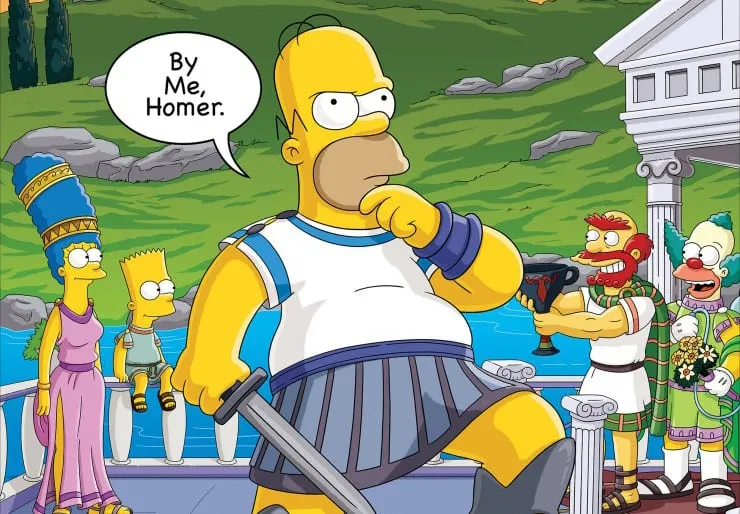
No, not that Homer.
Knowledgable readers may balk at the idea that Homer even existed, or put forth the claim that both the Iliad and Odyssey come to us in their current form as a hodgepodge work of many authors. Well, these objections just further emphasize the usefulness of predicting authorship! Imagine how nice it would be to pair each collection of lines with a certain author and to show how the tapestry of the Iliad was formed.
Hopefully by now you’re amazed at how useful a project like this could be, and at the same time convinced that an endeavor as large as this is a bit much to do as a part-time data science project. It is a worth-while project that could do much to help classicists reach a consensus on issues of authorship (HA!).
In my next blog post, I will do something similar to this one for #2 on our list. So if you’re not interested in these background posts, please stay tuned for an upcoming post about the nitty-gritty coding and data science portion of my project.
Οὖτις ἐμοί γ’ ὄνομα
“My name is Nobody”.
— Homer